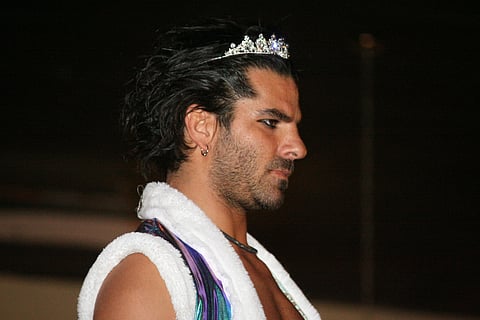

Jimmy Jacobs as 'Zombie Princess' | Image Credits : Mike Kalasnik (Flickr) via Wikimedia Commons

Sportshadow got the opportunity to interact with former WWE, TNA, and AEW writer and five-time ROH World Tag Team Champion Jimmy Jacobs.
Known for his long form feuds in the independent circuit, Jimmy Jacobs spoke on a myriad of topics like his ROH stint, epiphany to turn into a writer, interactions with Vince McMahon and Tony Khan, writing the Festival of Friendship, and working with John Cena and Roman Reigns.
I started my career in 1999 when I was a fifteen-year-old kid. I was very small, and my first idea was to enter the ring on a pogo stick as "Jumping" Jimmy Jacobs.
I realized that people were not going to take me seriously anyway because I looked so young, so I figured that at the end of the night, they would at least remember the kid on the pogo stick. That was always my thought process: I had to stick out.
There is always a balance in life between unity and multiplicity—or sameness and uniqueness—and you need a balance between the two.
I always felt that while you want to be able to wrestle and do what everyone else is doing, you must find a way to distinguish yourself from the bunch. That philosophy remained in my thought process throughout my entire career.
My character slowly developed as I grew. Once I outgrew the pogo stick at age eighteen, I decided I was done with that phase. That is when I got the furry boots and started performing the "Mini-Bruiser Brody" style. That transition worked well for me and helped me get into Ring of Honor.
Eventually, my in-ring style developed further. Because I am a small guy who does not do much high-flying, I had to take a different avenue. Much of what I did was rooted in the essence of professional wrestling, which led to intense blood feuds and crazy matches.
Consequently, I started to gain a reputation as someone who would or could engage in more violent content. However, for me, that violence was always primarily about the context of telling stories in professional wrestling.
That was what I was good at. Ring of Honor was a place where the wrestlers were incredibly athletic and performed great matches. You could watch the top Ring of Honor matches in a vacuum and still think they were very cool.
However, that was not my specialty. To me, professional wrestling requires context. It needs stories, angles, and characters. One person wants something and another person wants something else; when those two desires cannot mutually coexist, you have to settle it.
I discovered this about myself in my early twenties while working for Ian Rotten in IWA Mid-South. That was probably one of the first times I realized how to execute multiple matches to tell stories and build feuds. I began to see that storytelling was where I was most adept.
My rivalries with BJ Whitmer and Seth Rollins were based on personal issues. BJ and I were former tag team partners. I basically left him or walked out on him because I was in love with our manager, Lacey.
Once that happened, we were off to the races. That is professional wrestling. I believe professional wrestling is often represented best in the context of those personal issues.
BJ and I were the Ring of Honor Tag Team Champions in 2005. We had a babyface run that was fine, but because we won the titles the very first time we teamed together, there was nowhere left to go.
We had no real feuds as a tag team; aside from two matches with The Carnage Crew, we mainly just performed title defenses. Once that run ended, the logical next step was to turn heel, as we had already exhausted our potential as babyfaces.
Gabe Sapolsky, the booker of Ring of Honor at the time, paired us with Lacey. After a few months, the act was not gaining much momentum.
In late 2005 or early 2006, Gabe emailed me. He admitted that he did not know what "emo" was, but he knew he wanted to punch emo kids in the face.
He noted that people were calling me "emo" and asked if I could develop an emo character. At the time, I wore nail polish and eyeliner, but I did not actually know what "emo" meant. I researched it and realized it was a viable path.
I pitched Gabe an idea: I would be in love with Lacey, but she would not love me back. I wanted to portray a kid who was completely torn up by this unrequited love. We decided the story needed a "jock" character to win the girl, leaving me as the loser emo kid who fails to get her.
The story began to take shape through that initial collaboration with Gabe. This eventually led to me creating "The Ballad of Lacey," which is the element that truly launched the entire angle.
"The Ballad of Lacey" is probably my most important work because it saved my career. I have told this story many times, but in early 2006, I called Gabe Sapolsky while I was drunk.
I told him, "Gabe, I need an angle. I need a story. I cannot just have one-off great matches like the other guys; I need characters and narratives."
Gabe responded by telling me that while stories and characters are nice, the matches are what sell the DVDs, and he felt I did not have those kinds of matches.
He pointed out that when they put the tag team titles on BJ Whitmer and me, we were supposed to be an attraction, but we did not do anything with the opportunity.
He told me we would do a match in Detroit that March to see how it went. Gabe later went on record saying he was actually planning to finish me up; I was basically done with the company.
I told Gabe, "Let me do something. I do not know what it will be yet, but I will make something and send it to you to get this thing going." He told me to go for it.
My friend and I wrote and recorded the song, and another friend helped me create the music video. As soon as we finished it, I knew it was the right move. I am willing to admit my faults and deficits, but I also give myself credit when it is due.
When I finished "The Ballad of Lacey," I knew this was the thing that would move me away from the "Huss" chants—since people were still chanting that from the Mini-Bruiser Brody gimmick I had done a couple of years prior. I knew this was it.
I sent the tape to Gabe. Because this was twenty years ago, it took about two weeks for him to receive it. During that time, I was waiting to see if it arrived and whether he would hate it.
Because this was twenty years ago, the process was slow. I sent the tape and anxiously wondered if it had arrived, if he had watched it, or if he hated it.
One day, while I was playing Nintendo 64, Gabe called me. He said, "Jimmy, I just saw your music video, and it is the greatest thing I have ever seen in my life. This is great. This is going to be your new theme song. Can you make the next show in Philadelphia?"
Gabe had not booked me on the East Coast in a long time, so I knew this was the breakthrough. He finally understood my vision. I told him, "Thank you. Now you see what I am saying." I realized then that you have to show people what you are about rather than just telling them.
A few months later, Gabe told me we needed a new music video. I am not a professional recording artist or filmmaker, but I agreed to do it. I used to joke that I was the only wrestler in Ring of Honor who received "homework."
Samoa Joe did not have to jump off a pier into a lake and pretend to die for his character.
Regarding the music videos, the second one, "Victory of Love," remains my favorite. I particularly like the storytelling in the scene where girls approach me on the pier.
Even though they want me, I am so consumed by my love for Lacey that I throw myself off the pier and eventually wash up on the shore dead. It was a very fun, creative time.
In retrospect, I am very happy with the storytelling and how that narrative transitioned into the next chapter: the Age of the Fall. Around April 2007, I was sidelined due to ACL surgery on my left knee.
While I was injured, Lacey and I recorded a series of four vignettes featuring us going on dates. In these segments, I tried desperately to win her love, but it clearly was not working.
However, at the end of the fourth date, we finally slept together. The segment featured the cameraman sneaking in after the act to find her cuddled up next to me, telling me she loved me.
At that moment, the camera captured a specific look on my face. It conveyed the realization that I had finally obtained what I thought I wanted, but it wasn't right. This planted the seed for the next iteration of my character.
Winning the tag team championships with Tyler Black was something which Gabe decided creatively.
In the summer of 2007, Gabe Sapolsky had the idea for me to lead a group similar to Raven’s Flock—essentially a band of degenerates. We both immediately agreed that Necro Butcher should be in the group.
Beyond Necro, I personally wanted Ricky Morton and Zach Gowen. I envisioned Ricky Morton playing a "down on his luck" star from twenty years ago, similar to a washed-up rock star. I wanted this group to look like nothing else in wrestling—a true band of misfits.
However, Ring of Honor placed a high priority on match quality, so we needed members who could perform that specific style. I suggested myself, Necro, and the tag team of Tyler Black (Seth Rollins) and Marek Brave.
Gabe brought Merrick and Tyler down to FIP, ROH's sister company in Florida, to evaluate them. He concluded that while Merrick was not quite ready, Tyler was "the guy."
Gabe tells a great story about Tyler’s tryout evaluation. While Tyler was outside the arena, some kids began causing a commotion and throwing rocks. Tyler shouted them down and stood his ground as they continued to throw rocks at him.
Gabe saw this and recognized Tyler’s toughness, charisma, and that intangible "it" factor. Combined with his high-level athleticism, Tyler was the perfect fit.
The final lineup became myself, Necro, Lacey, and Seth, with Seth and me serving as the tag team.
The original conception for the Age of the Fall served three purposes: first, to elevate me to the next level; second, to create a fresh tag team to work with the Briscoes; and third, to establish Seth.
Wrestling typically functions around a central figure or act. Whether it is John Cena in the singles division or the Briscoes in the tag division, one act sits at the top while everyone else serves as "feeders" to sustain them. To challenge the Briscoes, we needed a new, credible team.
The strategy was to place the brand-new Tyler Black with established performers like myself—an upper-mid-card act at the time—and Necro Butcher.
By associating him with established names, we provided the platform for Seth to eventually break out and become the major star he is today. That was the primary purpose of the Age of the Fall.
The two factions were quite different in several ways. During the Age of the Fall, I was essentially at the helm. Gabe Sapolsky, Seth Rollins, and I collaborated closely on the creative direction.
In contrast, Kevin Steen (Kevin Owens) was more at the helm of S.C.U.M. Kevin is a significant creative force who takes up a lot of "creative space." He is very good at what he does, and his ideas are not wrong, but it just was not my thing.
I was not leading; I was following someone else’s lead. It was fine, but it simply was not me driving the process.
I originally left Ring of Honor when I felt the Age of the Fall angle was wrapping up. I intended to take a few months off, but that absence ended up lasting two years, from 2009 to 2011.
The day I returned was the same day Ring of Honor announced that Sinclair Broadcasting Group had purchased the company.
This second run in ROH occurred under Sinclair ownership, and I did not enjoy the experience. I did not like the people running the company or the way they treated me; it was not a fun environment.
Even when I returned in 2017 for a single appearance after being fired from WWE, I realized by the end of the night that I still hated working for Sinclair.
I had planned to continue working for Ring of Honor, but TNA called me around that same time. When a representative from ROH contacted me about dates, I mentioned I was also working with TNA.
They told me I could not do both. I replied that it was fine and that I would choose TNA. I remain happy with that choice.
Although ROH eventually did impressive business, such as selling out Madison Square Garden, that success was largely driven by the momentum of the Young Bucks, Kenny Omega, Cody Rhodes, and the Bullet Club.
Personally, I do not have much affinity for my time in Ring of Honor from 2011 to 2015. I feel much more connected to my work from 2003 to 2009.
The move to creative was my choice. In 2014, I had an epiphany—a moment of grace—where I realized I had been running my head into a brick wall with wrestling for a long time. It occurred to me that I was supposed to be in creative; that was what I was meant to be doing.
By that point, I had already collaborated on the creative direction of my work in almost every company I worked for. I would suggest what I wanted to do or what I thought we should do. Much of that was good material, so I had experience generating and executing ideas.
In the summer of 2014, I fully embraced this new direction. The next time WWE was scheduled to be in the Cleveland, Detroit, and Grand Rapids area was December 2014, including a pay-per-view in Cleveland.
I contacted Seth Rollins and asked him to get me booked as an extra for those three dates. I then called Joey Mercury and Bryan Danielson individually.
I told them I was booked as an extra, but I was not going there to seek a job as a wrestler; I was going there to get a job as a writer. I asked for their help to put me in front of the right people.
Joey and Bryan followed through and brought me directly to Dave Kapoor (Ranjan Singh), who managed the creative team at the time.
Bryan introduced me by saying, "This is Jimmy Jacobs. He is a genius, and he belongs on your team." I could not have asked for a better introduction.
While the administrative process took some time, it was smooth sailing with no obstacles. After hitting a brick wall for years in my wrestling career, the door to creative suddenly unlocked, and I walked through it.
The process lasted from December until I officially started on April 1, 2015. It took about four months to seal the deal, but the transition happened easily.
I had to earn my rank. It helped that I had existing relationships with people like Kevin Owens and Sami Zayn because they already trusted me.
However, in this environment, previous accomplishments do not matter; you must earn trust daily. I had a significant amount to learn. When I see people criticizing the creative direction of the show, I understand their perspective, but they do not know the backstage process.
I was shocked to discover that even the wrestlers in WWE do not fully understand the creative process or how it works. Despite spending sixteen years in the wrestling business, I realized I did not know what I did not know.
I initially expected to find "Hollywood writers" who knew nothing about wrestling, but after spending ninety minutes in the writers' room, I realized everyone there was incredibly smart and understood the business.
The job is difficult. We produced three hours of Raw, two hours of SmackDown, one hour of NXT, and a monthly pay-per-view, all while constantly generating new material.
I learned quickly that WWE creative, especially under Vince McMahon, was closer to fast food than a five-star restaurant. We would finish Raw on Monday, execute SmackDown on Tuesday, and immediately begin working on the following week’s episodes.
The medium of wrestling is naturally limiting. Most stories involve two people fighting because of a personal issue or a desire to be the best. You have to dress that concept up in a million different ways for seven hours of television every week.
Additionally, Vince McMahon was a significant "X factor" who changed things constantly. Because he would often decide on a Monday to scrap a plan, long-term storytelling was nearly impossible. I believe that lack of long-term planning was one of the primary problems with WWE creative at the time.
When you start on the creative team, you work on pre-tapes with the "filler" acts. My first real assignment was the Social Outcasts, consisting of Adam Rose, Bo Dallas, Heath Slater, and Joe Hennig (Curtis Axel). I had a great learning experience working with those guys.
Shortly after that, Chris Jericho returned, and I began working with him. I eventually became "Jericho's guy," which led to working with him and Kevin Owens. Later, I became the primary creative contact for AJ Styles.
By the end of my tenure, I worked with John Cena because his regular creative partner was away. The last project I worked on for Raw involved Cena and Roman Reigns, and I also handled Cena and AJ Styles on SmackDown.
You start at the bottom and earn the performers' trust. Jericho is a perfect example; he did not know me personally at first. He was focused on his own performance, and I had to prove that I could help him rather than hinder him.
It was difficult initially, but once he saw that my ideas worked, he trusted me. That trust allowed our collaboration to thrive and enabled the performer to let the creative process in.
The "Festival of Friendship" stands out head and shoulders above everything else I did. I remember writing and rewriting that segment for days.
Two days before the show, I was completely strung out on Adderall, constantly revising the script; in fact, I went to rehab only two months later.
The night before the segment aired, I felt the same anxiety I used to feel before a major wrestling match. I knew it was a big moment.
The day of the show was rough. Vince McMahon was not there, and Triple H and Chris Jericho had several differences regarding the creative vision. We had to work hard to get the segment to where we wanted it.
Ultimately, everyone was very happy with the result, including Triple H. When it ended, I knew we had succeeded.
I was deeply involved in that segment, but it is often difficult to claim sole credit. People like to point fingers at the writers, but the process is incredibly collaborative.
So many people have a hand in the final product that it is hard to say, "This was mine; I wrote this." You count on the performer to pull it off and make the material their own.
For example, I had a specific vision for "The List of Jericho." Originally, Chris had a crumpled piece of paper in his tights that he would pull out. We transitioned that to a metal clipboard, which provided a strong visual element and something he could use to hit people.
We also added the detail of him pulling out the pen and clicking it. You need all those small elements working together to create something memorable.
I also worked with Roman Reigns and John Cena toward the end of my tenure. I produced the famous promo where Cena told Roman, "You can consider me a drug test, because you ain't never gonna pass me."
Cena actually ad-libbed the part where he threw the microphone. I produced a lot of fun segments, but many of them run together because of the relentless schedule of producing shows every Monday and Tuesday.
Vince McMahon was a micromanager. While I loved working for WWE and enjoyed so much of it, I had a very difficult time working for Vince. I do not think I was alone in that experience; much of the culture there was based on a fear of him.
I saw this transition within myself: I went from trying to do the best possible thing to simply trying to figure out what would not get me in trouble. I stopped taking risks and instead focused on what Vince would not yell at me for.
This resulted in a roster of people playing "not to lose" as opposed to playing to win. In my observation, Vince McMahon acted as the archetype of the withholding father.
He was a master at withholding praise until he was ready to give it. Consequently, you had a group of people constantly looking to one man for validation, asking, "Am I okay? Is this good?"
Vince criticized almost everyone at some point; nearly everyone ended up in the "doghouse." While performers like Brock Lesnar, Roman Reigns, and legends like The Undertaker were on a different level with him, Vince would regularly disparage the rest of the roster.
I remember high-level, top-tier performers main-eventing Raw in matches they—and I—thought were good, only for Vince to completely tear them down.
These performers would walk away wondering if they even knew what was good anymore because Vince had just yelled at them about their match.
The culture essentially cast Vince as a bully. People spent their time trying to avoid his anger or being fired, all while desperately searching for his praise.
This happened to me, and I saw it happen to others. People craved his approval, but he would give it and then withhold it again, running hot and cold.
I believe professional wrestling attracts people who are often insecure. You base your life and worth on the noise strangers make; if they cheer, you are good, and if they do not, you feel worthless.
The culture under Vince McMahon exacerbated that insecurity. It heightened the psychological pressure significantly.
I saw people wrestling for the Intercontinental Championship one week, only to be relegated to catering for a month the next. They would wonder what they did wrong or what happened, but the reality was that their careers were subject to the whims of a volatile individual.
Despite this, and regardless of the person he allegedly is or the person I saw him to be, I am grateful that I had the opportunity to work under his tyranny for two and a half years.
Vince McMahon never called me to fire me; I was not high enough on the totem pole to receive a "Vince Fire." I was at a television taping in Ontario, California, when a friend texted me asking if the Young Bucks were outside the arena. I told him I did not think so, but he insisted they were.
I went outside and saw them. I have known those guys for years and was very happy for their success, as they were "white hot" at the time. As I was leaving, I asked them to take a picture with me just for my personal collection.
Later, during Segment 4 of Raw, I was standing in the gorilla position and decided to post the photo. I knew people would not be happy about it. Within thirty minutes, my boss pulled me into a room and demanded to know why it was happening.
We finished Raw on Monday and SmackDown on Tuesday. I then went on a family vacation and returned for the following week’s shows in Colorado.
The next Thursday, I was in the office. I told myself that if I made it through the day, everything would be fine. However, first thing that morning, the administrative assistant told me to go to HR on the second or third floor. I knew immediately that I was getting fired.
I did not take the photo thinking I would be fired, but looking back eight and a half years later, I realize I was acting out.
I was unhappy at WWE. I had gone to rehab in 2007 and returned to work without the "filter" or "numbness" that drugs provide to make reality digestible.
Suddenly, I had to deal with Vince McMahon’s management style without that buffer, and I realized I did not want to be there.
During my final months, I was not enjoying myself. I would sit in production meetings and look up other things to do with my life, such as working on a farm in exchange for room and board.
I even looked at different wrestling costumes, wondering what I would wear if I returned to the ring.
I was an unhappy person who had never learned how to ask for what I needed. If I had the self-awareness I have now, I would have sat down with my boss and explained that I was unhappy and asked for a transfer to NXT or the Performance Center. Instead, I just took the picture.
Part of me resented being judged by things other than my work. Vince would criticize me for wearing a pink tie or talking with my hands. I felt like saying, "Fine, I am a weirdo, but I am good at this.
Let me be a cog in the machine, even if that cog has sparkles on it." I understand it was his "sandbox," but I was the problem because I could not get over those idiosyncrasies.
People I worked with closely respected me, but at Vince’s level and with those close to him, I felt they could not see past my personality to the quality of my ideas.
When I was finally fired, I felt relieved. I had been terrified of being fired or quitting, but once it happened, it was over. I had the time of my life over the next three months on the independent circuit.
I realized that if I had not been fired, I would have held on to that hard-earned WWE job for another ten years and been miserable until I died.
I view that incident as a moment of grace. The universe, or God, taught me that I did not need to be scared to make a jump. It was a "free pass" because I never would have left on my own.
It taught me to have an act of faith and step away from what is no longer for me. That lesson stayed with me when I eventually chose to quit AEW.
WWE and AEW are very different in terms of process, production, and protocols. AEW is obviously a newer company, so it lacks the extensive infrastructure that WWE possesses. WWE is a machine.
When I started working there, I spent months in amazement as I saw how the "sausage is made." Every "cog" in that machine has to move in a specific way to make the whole thing function. It is truly incredible.
AEW simply did not have the same infrastructure, protocols, or processes. That absence can be helpful at times, but it can also be a hindrance. It really comes down to a balance between order and chaos.
A lot of the time, WWE suffered from too much order. Vince McMahon micromanaged everything; he looked at every single word in every script.
I remember getting called into his office because I used the word "violence" or "violent" in a script for Samoa Joe. Joe never even said the word on television; it was just written in the document.
Vince confronted me, telling me that we do not use that word in WWE. I had no idea there was a ban on it; nobody had ever given me a "dictionary" or "bible" of forbidden words.
That is how micromanaged the environment was. I understand the logic behind it to an extent. There is often an urge, when something goes wrong, to create a new rule to fix it.
Management decides that moving forward, a specific rule will prevent a specific problem. You see this pattern in our broader culture as well.
In the United States, there are so many rules that no living human being knows them all. You find regulations for everything, such as the required height of your grass. Whenever an issue arises, society makes a rule about it, followed by another and another.
WWE functioned the same way under Vince McMahon. There were countless "crammed-in" rules designed to fix every potential problem. However, mistakes and failures are inevitable.
You try to mitigate them, but you cannot create a framework of order tight enough to stop every "leak" from happening.
AEW exists on the opposite side of that spectrum. The benefit of their approach is that talent and coaches have more freedom to execute their matches as they choose. The downside, however, is a "pathology of chaos."
In this environment, the structure is not always cohesive enough to ensure that different performers are not doing the same things, using the same names, or using the same finishers.
Without a rigid structure, matches can "step" on one another. A cohesive structure ensures that every individual part serves the whole of the show.
You can understand these differences fractally by looking at promos. In WWE, we had to write word-for-word scripts for the wrestlers, and Vince had to approve every line.
In AEW, Tony Khan might tell the wrestlers what topics to discuss, but the wrestlers decide how to say it. Sometimes that freedom works out, and sometimes it does not.
These are the two different energies—order and chaos—that we are constantly dealing with in professional wrestling.
My experience at TNA (Impact Wrestling) from 2017 to 2023 demonstrated a balanced approach to creative direction. Every talent is different; some are excellent at generating their own material, while others are not.
Some performers actually prefer a word-for-word script. For example, The Miz and Big Show both like to have a prepared script.
At TNA, we operated with a smaller creative team, which allowed me to be more hands-on. My process involves evaluating the talent individually. I prefer to let a performer try their own approach first.
I provide the key talking points—the "XYZ" of the segment—and then I sit back and observe their execution. If they are effective on their own, I do not need to interject.
My philosophy is to use the least amount of force necessary. If the talent is good, I let them be. If they are good but require minor adjustments, I provide a little guidance. If they struggle with promos, I give them exactly what they need to succeed.
Telling a wrestler that their main event path has changed is probably harder than convincing them to lose a title.
While champions can sometimes be difficult, most of my experience in WWE, TNA, and Ring of Honor suggests that wrestlers will ultimately do what you ask of them. Almost everyone, at the end of the day, follows instructions.
However, some performers will never agree right off the bat because they always want to collaborate. For example, I like Bully Ray and think he is very smart, but he is not an "easy" talent.
He would likely admit that himself. It was never easy working with him, but we always reached the necessary conclusion. He wants to make everything the best it can be, which is often great, but it depends on the specific wrestler.
It always blows my mind when I see a wrestler straight-up refuse to do something. Your job is to take whatever the boss wants and make it the best. If you are a good performer, you can make almost anything work.
I saw talent "buck back" against Vince McMahon, and even I occasionally thought some of his ideas were horrible. However, once the talent executed those ideas, I realized they weren't bad and I could see what Vince was going for.
Before execution, you are always negotiating. You eventually learn that if the performer is good, they can pull off almost anything. Again, that is your job: you must turn poor ideas into good ones and good ideas into great ones.
From what I have seen, the creative direction has been quite good. Although I do not watch every week, and while there has been more critical scrutiny this past year compared to the year before, the company remains very hot.
In 2024, they were selling out arenas everywhere. Some of the issues I had with Vince McMahon’s style are no longer present.
Under Vince, if two people were wrestling on a pay-per-view, they were glued together in segments every week leading up to it. If I have a match, you do commentary; if you have a match, I do commentary; or we compete in a tag match together.
Vince avoided involving other people because he did not want to "cross stories" or split the spotlight.
In contrast, what I see now is much more dynamic. For example, in a segment a few months ago involving Gunther and Goldberg, Gunther cut a promo, followed by CM Punk, and then Seth Rollins appeared.
Because Seth had the Money in the Bank briefcase, Punk chased him through the stands, where LA Knight was waiting to fight Seth. After a commercial break, Punk and LA Knight were backstage arguing over who had the right to fight Seth at Saturday Night’s Main Event.
Now, everyone has multiple conflicts. You do not know if Gunther will lose to Goldberg, or if Seth will cash in on Goldberg, or how LA Knight and Punk fit in. With Vince, everything felt telegraphed and hammered into the fans' heads repeatedly.
Once you realize that Vince McMahon is a promoter rather than a storyteller, everything he does makes sense. He is not fundamentally a TV writer or even a wrestling booker; he is a promoter.
He focuses on what goes on the marquee. He wants to smash an idea over the fans' faces repeatedly so they know exactly what is going to happen. I have been impressed with how the current creative has moved away from that.
Triple H is a "human" version of Vince. Everything you have heard about Vince is true and more; he is like an anomaly or an alien from another world. Triple H is a dude you can actually talk to.
With Vince, the success of a pitch depended entirely on how you presented it. If a pitch was too long, did not cover enough, or was even slightly confusing, he would get frustrated and blame you.
Triple H is someone you can collaborate with; you can suggest an alternative idea, and he will listen.
Their views on wrestling are also quite different. Vince always said to "err on the side of entertainment." Having sat in the guerrilla position for forty years, he had seen everything and just wanted to be entertained by something that "popped."
Triple H is much more grounded in believability. It is still wrestling, not reality, but his approach is more about two athletes competing over personal issues. Their creative perspectives are quite different.
Tony Khan is a "dude"—the kind of person you can just hang out with. I genuinely like him. I have never met anyone who loves professional wrestling as much as Tony Khan does. In fact, his passion was actually one of the factors in my decision to leave AEW.
Every Wednesday and Saturday, I saw him arrive at the arena, and it was clear there was nowhere else in the world he would rather be than making that television show.
Seeing his excitement made me reflect on my own state of mind. I wondered why I no longer felt that same passion or fire. I used to feel that "let’s do this" energy, but instead, I was showing up feeling stressed and pressured.
I was constantly in my own head about things. While there were many personal and professional factors involved in my departure, noticing that gap in our respective levels of excitement was certainly one of them.
Tony’s view on wrestling is evident in the product he produces. He loves athletic competition and what people call "banger matches"; that is his specific brand. However, he also occasionally introduces elements that are a bit silly or off-the-wall.
I always appreciate those moments because wrestling is naturally "out there." Comedy is a great fit for the medium. Tony would sometimes come up with these unique character ideas, and I would fully support them because I love the inherent weirdness of wrestling.
Tony is a good guy, and like every other boss I’ve had, he has his own distinct way of doing things.
I believe my relationships with Seth Rollins and Kevin Owens remain consistent. Unless you make a conscious effort, you tend to stay friends with the people you are around. You are essentially "playing the same game" together.
Back in the Ring of Honor days, we shared a great sense of camaraderie. We were all young guys who wanted to change the wrestling business. We shared the same aims, goals, and drive.
Seth and I are not as close now, and we do not speak very often. Kevin and I probably talk once a week. As far as I am concerned, they are the same guys they have always been.
I cannot speak to how they interact with the rest of the world, but they are good people to me. It is amazing to see both of them succeed. Both guys have main-evented WrestleMania.
When Kevin main-evented WrestleMania against Stone Cold Steve Austin a couple of years ago, it blew my mind. I actually texted him last week to remind him how "nuts" that was. I am incredibly happy for their success.
It is difficult to determine who would be the better booker among Seth Rollins, Kevin Owens, and Sami Zayn. All three men are exceptionally creative regarding their own characters and performances.
That is their primary focus right now, much like my own focus was a dozen years ago. However, it is hard to predict how that internal creativity would translate to managing and directing other people.
I believe all three would be fairly successful in that role. Seth, Kevin, and Sami all possess excellent minds for the business and fundamentally understand what professional wrestling is.
That is not a given in this industry; many wrestlers, even some at the highest levels, do not actually understand the essence of pro wrestling. They often lack a cohesive vision of the "big picture." These three, however, truly grasp the craft.
I believe writers and producers probably deserve Hall of Fame recognition. Several individuals have worked backstage for WWE who possess Hall of Fame-caliber careers behind the scenes as well as in front of the camera. Michael Hayes is a prime example of someone with that dual success.
There are others, like Pat Patterson and even Ed Koski—who has served on the WWE creative team for approximately twenty-five years—whose contributions remain largely unknown to the public. Most people do not realize how many hands actually collaborate to create the final picture of the show.
However, I recognize that the WWE Hall of Fame is also somewhat of a "gimmick." For example, while I consider Brian Gewirtz a genius and incredibly smart, I wonder if the fans would actually care about his induction.
For the purposes of a Hall of Fame television production, management probably would not induct a writer just for the sake of the show.
The toughest wrestler to write for was Roman Reigns during the 2015–2016 period. Although I worked with him only minimally, he was a babyface who lacked a strong, defined character voice at the time. We were still trying to find his specific identity.
This difficulty was compounded by the fact that Vince McMahon was incredibly hands-on with Roman.
Vince had decided that Roman was the "next guy," so all eyes remained constantly on everything Roman did. Roman had not yet found the strong voice that eventually emerged with the "Bloodline" storyline.
My critique is not a slight against Roman himself; rather, it is an observation that writing for a top babyface without a strong voice is inherently difficult.
Heels have more creative freedom; you can be ridiculous or go "off the wall" with a heel character. However, the creative path for a babyface is much narrower, especially when you reach the top of the card where so much is riding on the performance.
An undercard babyface can get away with saying something generic, like "I’m going to kick your ass," but when you are at the top, the expectations are higher.
Finding a voice that the audience will genuinely like within that narrow path proved to be very difficult.
This is an exclusive interview by Sportshadow.com. Media outlets using quotes from this article are requested to provide a backlink to this article or the website's homepage alongside embedding the video interview published on Youtube.