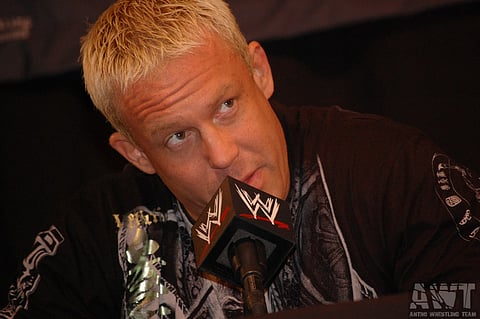
Ken Anderson during his time in WWE | Image Credits : Felipe Bascunan (Flickr) via Wikimedia Commons

Sportshadow got the opportunity to interact with former two-time TNA World Heavyweight Champion and the 2007 WWE Money in the Bank winner Ken Anderson.
Fondly known as Mr. Kennedy in WWE and Mr. Anderson in TNA, the 49-year-old discussed about everything from working in-ring with legends like the Undertaker and John Cena to his backstage discussions with authority figures like John Laurinaitis and Vince McMahon.
When they instituted the wellness policy, a majority of the roster were using performance-enhancing chemicals. We were running a really rough schedule—five days a week, sometimes seven if we were doing international tours.
When you go from taking synthetic testosterone to nothing at all, it’s often more detrimental to your health to suddenly stop without weaning off the substance.
A lot of guys were experiencing this, yet we still had to keep that schedule. I specifically asked Johnny Ace, "What are we supposed to do?" He said there are wellness clinics you can contact that will give you a prescription.
He told us as long as you have a legit doctor's prescription, you're going to be okay. If you pop for a substance, they would look at the prescription and you’d be fine.
So that’s what I did. I contacted a doctor, did blood work, and he prescribed me three different things. He said they would take care of filling the prescription and sent it to me. I didn't have to actually go into a pharmacy.
The story was that a baseball player tried to fill 12 months of growth hormone at once. Someone at the pharmacy thought it seemed weird and looked into it, and it turned out that doctor was shady.
I had no idea. This was someone I was turned on to by the company, or someone within it. Apparently, there is a clause in the wellness policy that says you can't get a prescription filled by an online pharmacy. That doctor happened to get them filled through one. That was the loophole.
I told them, "I did what you guys told me to do," but Vince said his hands were tied. At the time, Congress was looking at baseball and pro wrestling because of the Chris Benoit tragedy.
He suspended me for 30 days, along with 10 other people, and fined me $10,000. I still wonder where that $10,000 goes to. That was it—no ifs, ands, or buts about it.
The thing that really caught us off guard was that the next day, it was on SportsCenter and ESPN that ten WWE performers were suspended. There is never a full explanation provided.
Everything usually involves nuance, and they never gave an explanation as to what the circumstances were leading up to that. It is just, "Hey, these guys got caught with steroids," which sounds terrible to the average person.
But when you look at what was actually going on, it wasn't as nefarious as it seems on its surface.
Unfortunately, at the time, I was involved in a really cool storyline that could have changed my career and been very positive for me. They were literally about to reveal me as Vince's son.
He said, "You're suspended for 30 days. We're still going forward with this storyline—we have to. So, sorry about your bad luck."
I shouldn't say I don't have regrets, but I can't dwell on it. It happened and it's a learning experience. Like our successes come from our failures.
If anything, I'm able to pass that knowledge on to other people. Hey, this is what I got caught up in. Be careful that you don't get caught up in this same sort of racket.
I went home for 30 days. Literally nothing to do. It's not a personal thing. It's just the business has to keep rolling whether you're there or not.
And I just happened to not be there. I knew that once the suspension was up, I was just going to slip right back in and they did. I got back in after my 30 day suspension and I got involved in some storylines.
I heard Steve Austin put it this way, that we are just cogs in a machine and every once in a while you take a cog out and you just grab a new one and you put it in and the machine keeps rolling and that's just life. So, I don't ever take stuff like that personally.
The only thing I was privy to creatively was that I was going to be revealed as the son. That was literally all I knew. In our business, the performers often are not clued in as to what is going to happen until the day they arrive.
This happens for two reasons. First, things change; people get injured, people get suspended, or a storyline isn't connecting with the fans, so they have to go in a different direction.
Second, we like to surprise and entertain people, and part of the entertainment is the surprise factor. For some reason, some people get a kick out of saying, "I know what is going to happen," and then they spoil it for everybody.
For example, when John Cena came back for the Royal Rumble in 2008, only about three people knew he was returning.
When Matt Hardy came back, jumped the guardrail, and beat up Edge, only Vince, Edge, Michael Hayes, and Matt Hardy knew that was going to happen. Everyone else was in the dark. Even the security guards thought it was a "shoot" and believed it was real.
We often aren't clued in because you never know who the stooge is. Somebody is always looking to send Dave Meltzer an email, so we try to avoid that as much as possible.
I was always totally fine with that. Tell me on the day, let me know what to do, and point me in the right direction. Give me a little time to get my head around it creatively, and let's go do it.
They show you the conversations that occur, but those are worked, too, I believe. They just talk about it beforehand, before the cameras start rolling.
They say, "Hey, we're going to talk about how this match is going to be structured, how it's going to go down, what the aftermath is going to be, and where we're going from there."
They are not peeling the curtain back entirely. If there were cameras rolling 24/7, 365, it would be a different story. They are letting people in, but not entirely.
To me, when I first broke into the business and started understanding how matches work and how the magic happens, I fell in love with the business even more. I thought, "Wow, this is actually amazing what these guys are able to do in that moment."
Oftentimes, we don't plan everything out. We are listening to the crowd, and something happens organically, so you go with it. It’s a little bit of improv.
Other times, it is fully scripted, depending on the performer. Some performers work better that way, where they memorize every single move, every duck, every punch, and every kick. So, that's my take on it.
The other thing I want to say is that Hollywood has been giving us behind-the-scenes footage as extras on DVDs for years. If you buy the Iron Man DVD, you get three hours showing how they did every trick. You see him on the wires and you see the green screens or blue screens behind him.
At no point has anybody ever gone, "Oh man, I thought that was real. Now I know that Iron Man isn't really flying around. They don't really hate each other. Now I can't watch." No—it makes you appreciate it even more. Then, when you see the finished product, you think, "Wow, that's beautiful." That is my take.
At some point in my WWE career, I stopped. I was punching the clock. I don't mean that I was phoning in my performances; I was still giving 100%. I just lost that spark and drive. We could spend days unpacking all of that, but looking back now, I pinch myself. I can't believe I did that stuff.
My first pay-per-view was against Bob Holly. There was no buildup; it was just a match. Then they put me in a match with Batista for my next pay-per-view.
Because Batista was up here (a level above) and I was here (a level below), I thought it would just be me getting my ass kicked.
When I got to the building, I asked our producer, Arn Anderson, "What are we doing?" He said, "This is a competitive match. It is going to be back and forth, just a regular competitive match."
The way that match transpired changed my career. It solidified me as a mainstay and opened the eyes of Undertaker. Taker already had his eye on me, but when he saw that, he said, "Okay, I want to work with this kid."
Taker pulled me aside and said, "I saw what you did with Batista. I liked it. I think you and I can make some money. I'm going to go to the boss." He did, and the boss said, "Let's do it."
Taker came back and told me, "We're going to do a program. We're going to get at least three pay-per-views out of it." We ended up married to each other for about a year. It was me, MVP, Kane, Taker, and Batista working together for an entire year.
The lengthy program I did with Shawn Michaels was really special to me. Winning the Money in the Bank briefcase at WrestleMania was crazy. I didn’t tell anybody about that.
We spoke earlier about spoiling surprises; I told only one person close to me whom I could trust. Other than that, nobody knew it was happening except the people involved in the match.
Doing Tribute to the Troops was really meaningful; we went over and entertained the troops in Iraq, which was a cool experience. I had so many cool experiences—the television interviews I did and getting to do a movie. When you work for that company, it is such a huge machine and a whirlwind.
So much is crammed into a short period that I’ll see a clip and not even remember it. Recently, I saw a clip of me and MVP working Taker and Kane on Smackdown.
There was a hearse parked in the entryway, and I got in the car, revved it up, and went to hit Kane with it. I don't even remember doing that. I'll see a match and think, "I didn't even know that guy and I ever worked together." It's crazy.
The funny thing is that for years, anybody behind the scenes who knew Undertaker knew he was far different than the character you see on TV. People would ask me what he is like, and I would say he is nothing like the character; he is a laid-back, cool guy.
He was the locker room leader, not just because of his tenure or because someone commanded us to respect him, but because he is a great guy.
He was also very quiet; he isn't loud or boisterous. He is just there. If something in the locker room needs addressing, he addresses it, but he was always kind and honorable about how he handled things. If someone was acting up, he was able to say, "Hey man, don't do this. Stop it."
The first time I worked with him, we were on a loop of house shows starting in Oklahoma City. I approached him and asked, "What do you want to do tonight?" His response was simply, "Just listen to me." We didn't call anything in the locker room.
He said, "If I tell you to duck, punch me one time. If I say kick me, kick me one time." Knowing that was all I had to do was freeing. I felt relaxed and confident going into that match because I knew I just had to make sure that one punch looked good and that one kick was solid, without hurting him.
It went well. I remember coming back from that match, and he said, "That was great. I loved it." The next night, he asked, "What is something you would like to do? Give me a move or a spot."
Moving forward, a lot of our matches were like that. We would have a few spots called, like going over to the announcer table or the scaffolding to do something specific, but all the stuff in between was on the fly. He would call it, or I would call it to him, though he called the majority of it to me.
I had him on my podcast, and he said that when he was given fresh guys to work with, they were oftentimes shaking in their boots because they were overwhelmed by working with the Undertaker.
They would get super nervous, but I just wasn't nervous. I was confident in my own abilities, and I think he felt that confidence in working with me. He knew he could just say, "We're going to call it in the ring." He had seen me do that with enough other guys before.
For example, I worked with Booker T, and it was the same thing—we just called it. When I came back through the curtain, he said, "That was exactly what I was looking for. Good."
It is a good skill for people to learn to be able to call it on the fly. I tell my students all the time to get in that habit. Even if you are practicing a spot and it goes wrong, figure out how to fix it on the spot. Do not stop and reset.
Act as though you are live in front of an audience and fix it. The more that happens, and the more you fail, the more you figure out how to succeed and how to not fail again.
I was never a big John Cena fan, and he was not a fan of me. We didn't see eye to eye, but we were able to work professionally. That's the thing; I don't have to love everybody I work with. Especially at that level, you are just a professional. But yeah, we didn't always see eye to eye.
I really can't speak for him. I was there to do my job, and I always felt like he was sort of against me and would bury me to the office. Other than that, I really can't say, and I don't want to speak for him.
Again, it is what it is, and we didn't see eye to eye. However, I left the company in 2009, so it has been nearly 17 years. He is a different person, and I am a different person. I know that I am; I don't know if he is or not.
He always called me by little things, like "son." I think I am older than him and I served my country, so that type of stuff just rubbed me the wrong way. I would just take it on the chin, but that's about it.
If after all these years we met somewhere and he extended an olive branch, I would absolutely accept. I am like that with anybody. Truly, I don't hate anyone.
Even the person who causes me the most amount of angst and suffering in my life right now—if that person tomorrow said, "I’m sorry, we’re good, let’s move forward"—I would.
There is no dwelling on it, and I don't think about it a lot. I only think about it when someone asks me. I am not sitting here all day long thinking, "I really don't like John Cena," because I just don't think about it.
Moving to TNA definitely helped me mentally. I went from WWE, which had an intentionally toxic environment at the time. The boss likes for guys to feel like they are walking on eggshells all the time, which is uncomfortable.
You didn't get that in the TNA locker room; you just showed up, went to work, did your thing, and that was it.
I remember Paul Heyman telling me a story where he talked to Dixie Carter about getting rid of some older talent to focus on younger talent. Her response to him was, "Well, those guys have not done anything to deserve to be fired, so I'm not going to fire them." That was it.
WWE was all about dollars and cents; it is a machine that keeps rolling. There is very little human element. They didn't really care about what you had going on in your personal life.
They didn't care if you missed your kids' birthdays, baseball games, Christmases, or Thanksgivings. It was: "You need to be here and do your job; if you have personal issues, deal with them on your own time."
TNA was like a family. If you were having an issue, you could talk to Dixie, her husband Serg, or anyone. The boys just showed up, did our thing, and tried to do the best possible job.
I remember early in my career at OVW, Johnny Ace asked me, "Kenny, when are you going to start stepping on people?" I asked what he meant, and he said, "Are you here to make money or make friends?"
I remember thinking I could do both, but they didn't see it that way. They saw it as being cutthroat; you need to step on that guy to get to the top. Some people effectively did that.
The TNA that you're seeing right now is special. They have really caught fire, and it's cool to see. But I also think it was a great time to be in the business and to be at TNA when I was there. I had a phenomenal run and just had so much fun.
Even though there were things that were frustrating—and you get frustrated with any job—overall, the positives outweighed the negatives.
With any job you have, whether you work at McDonald's or anywhere else, you will have a beef with things like why they do certain things or why you have to do them. You always have that armchair quarterback mentality, but overall, it was a positive experience.
It was a great experience. They really took care of me and featured my family. My kids just turned 12 years old a few days ago, so they were 11 at the time. They have seen videos and been to independent wrestling shows, but they never saw me work for one of the big companies.
My daughter had literally just told me, "Dad, you need to go work for one. I want to see you work for one of the big companies again."
When she said that, I already had this match scheduled for TNA. It just so happened that we were going to have the kids there that weekend. My wife and I set it up where she picked them up after school and told them, "We're going to go to a show tonight."
I think my wife told the kids I had a private training session at the academy, which is why I wasn't there, but that I was going to come and join them. Then my music hit, and it was pretty cool.
I would definitely be open for a WWE return. I think enough time has passed. There was a time when I was in TNA that I felt, from the bottom of my heart, I would never work for that company again.
I didn't want to run that schedule or deal with that stress of constantly looking over my shoulder.
However, I think things are different there now. It is very corporate. I know that if I go back there, at least at the beginning, it’s going to be a numbers thing. I don't have delusions of grandeur; it is just a very corporate company now.
Everybody thought Vince would die in the arena, like he would just kick the bucket one day during the middle of a broadcast. Vince was the type of guy who would get mad when people slept on the plane.
When the writers did overseas tours and took the corporate jet to London and back, nobody on the plane was allowed to sleep. He would say, "Sleep when you're dead, pal."
Famously, Vince would sleep only two or three hours a night. I think he sleeps with his eyes open because he doesn't want to miss anything. He is just always business—wrestling, wrestling, wrestling—but specifically WWE wrestling.
Vince was not very in tune with what goes on in the real world. Mike Mizanin (The Miz) had been with the company for ten years when People magazine did a special issue of the top 100 reality superstars. Mike was in the top ten from his time on The Real World.
Someone brought it to Vince's attention, and Vince asked, "What's The Real World? What is that?" They told him it was a show on MTV that had been one of the hottest things for ten years.
Vince said, "Oh, well, in that case, let’s push him." That is how Mike started getting his push; he went from a low mid-card guy to getting pushed because of that People magazine issue.
The interesting thing is that he had people around him who were dialed in. Paul Heyman has his finger on what is hot right now, and he is also able to look at trends and see what is coming next. It's crazy. Paul is really intelligent and has a high IQ, so he just has his finger on the pulse.
Sky's the limit for that guy. He gets it. He's so entertaining and knows what to do and say to get under people's skin. He's such a great, solid performer. I'm very happy for him and what he's been able to do.
He's so funny; he had the "I'm your Papi" thing, and he intentionally cuts his hair to look just like Eddie (Guerrero). It’s subtle; he doesn't even really need to say it, but I think the way he acts and dresses is a nod to that.
The thing is, we are working together. I am never going to say anything about my opponent if they don't have a comeback. Oftentimes, I will be the one who says, "Hey, you should say this about me."
That is how it goes in the business. When someone says something really nasty about another performer, not only has it been okayed by that performer, but usually the other performer suggested they say it.
Personally, I think the stuff with Tiffany Stratton and Charlotte (Flair) was agreed upon. As you mentioned earlier regarding the backstage footage, that was discussed as well. They are blurring the lines now; they make us feel that maybe she has crossed the line, but in reality, they were all fine with it.
Ultimately, I don't believe one person carries the company. If they fired Cody Rhodes tomorrow, WrestleMania would still be sold out. I don't think ticket sales would suffer. The WWE has become the attraction, and they plug and play whoever they want.
This is not a good thing for the actual performers because it takes some power away from them; you don't have a whole lot of bargaining power.
Luckily, there are other options. Cody could say, "If you don't do this, I'm going to go to AEW again," or, "I'm going to quit and go to Japan." He sells a ton of merchandise, so they don't want to see that happen. But ultimately, the WWE can say, "This is the way it is. Take it or leave it."
I think the sky's the limit for Bron, but we need to see some different layers from him. He has that "mad all the time" energy, but that only lasts for so long. We need to see multiple layers from him, so I'm interested to see what he does next.
Yeah, definitely. Bam Bam Bigelow was special for a big guy. His selling, what he was able to do, and his movement—he floated through the air. Bronson Reed has that same sort of energy.
I've heard that comparison before (with LA Knight), and I think it’s a good thing. I don’t see it as a negative. There is nothing truly new in pro wrestling; everything has been done. You just put your own little twist or spin on things.
I’ve heard that people compare him to The Rock and a few other people. However, if you talk to Eli Drake, LA Knight, or Shaun Ricker—the person backstage—that is just the way he talks.
His cadence and delivery are simply the way he speaks. I don’t necessarily think he is trying to emulate anybody. That is his character; that is who he is, and he is just displaying that for the public. I don't think he's trying to emulate anyone necessarily.
I tried to fight it as much as I could, but people would compare me to Stone Cold. They would say, "Oh, he's trying to be Stone Cold Steve Austin." I was never trying to be Stone Cold Steve Austin; he is my favorite wrestler of all time. I am sure that I naturally did stuff that emulated him, but it wasn't intentional.
I actually wrestled him (Zilla Fatu); I worked a match with him in my hometown about a year ago. I have been watching what he does and I follow him on social media.
He gets it, and I am really excited to see his progress. I am sure it is only a matter of time before he is in WWE or TNA. I know he recently did a match in TNA, so hopefully, he can turn that into a long-term thing.
Nowadays, these guys are such extreme athletes. They are so athletic that you really have to have that athleticism in your back pocket, or you have to have something in the character department. You really have to be able to pick up a microphone and talk, or you are left in the dust.
Host: WWE or TNA—where did you feel more free?
Mr. Anderson: TNA.
Host: Mic skills or in-ring work? What defines a pro wrestler more according to you?
Mr. Anderson: I honestly can't say either way. Some people are tremendous in-ring performers and others are characters. Both are equally important.
Host: A loud crowd or a respectful Japanese crowd?
Mr. Anderson: Loud crowd.
Host: Who is the most underrated wrestler you've worked with?
Mr. Anderson: Matt Hardy. He is a tremendous performer who just never got that monster push I think he deserved. I loved working with him; he's phenomenal and has a great mind for the business.
Host: Absolutely. I had the pleasure of meeting Matt a couple of times and I still can't get his song out of my head—back in the day in TNA, "I fade away and classify myself as obsolete." You just can't get it out. That was such masterful work from Matt Hardy, truly. I agree with you.
Mr. Anderson: Yeah.
Host: Toughest locker room environment?
Mr. Anderson: WWE. When I first got there, you really had to mind your P’s and Q’s. Everyone knows the chicken story with The Miz. I was there when Miz got kicked out of the locker room. That happened to multiple people; it was a rough go, and you really had to be on your game.
Host: Name one match you would redo if you could.
Mr. Anderson: As much as I love the cage match I had with Kurt Angle, I would do that over again. There are still some things where I wonder, "Why did I do that?" or "Why did I look that way?"
Host: What is the one word that describes Vince McMahon?
Mr. Anderson: I think this is a hyphenated word: bottom-line. That is all that matters.
Host: Shawn Michaels or Triple H—who understands talent better?
Mr. Anderson: I would say Hunter, based on what I have seen. I haven't seen much of Shawn's interaction with people behind the scenes. I have talked to people who know Hunter today, and he gets it; he understands what the boys are going through.
Host: What is the biggest advice you've ever received in wrestling?
Mr. Anderson: Just that a "no" today doesn't mean a "no" tomorrow. Similarly, a "yes" today doesn't necessarily mean a "yes" tomorrow, so always keep that in mind. One more thing: the people you step on on your way to the top are the people you're going to bump into on your way back down. Tread lightly.
Host: Your biggest regret?
Mr. Anderson: Asking permission to cut a promo at WrestleMania after I won the Money in the Bank briefcase. I was going to say, "Nice guys finish last. Thank God I'm an a-hole." I asked permission and was told, "Nope, you can't say that. You can't swear." Had I just done it, it was live. When I did it in TNA the next night, they were already chanting it. Had I had the WWE machine behind that, it would be a lot different.
Host: Your proudest moment?
Mr. Anderson: Wrestling in front of my kids at TNA.
Host: Roman Reigns or Cody Rhodes?
Mr. Anderson: A very, very slight edge to Roman Reigns.
Host: CM Punk or John Cena?
Mr. Anderson: CM Punk. I wish I would have said that faster.
Host: And now the third and final name: Randy Orton or Triple H?
Mr. Anderson: Triple H. No, I take that back—Randy Orton. I always said he is one of the best in-ring performers. He's amazing. He was a problem child in WWE and got in trouble a lot, but he was like a "Teflon Don." Nothing would stick because he is so damn talented that you are just happy he is there.
Host: Randy Orton is still going strong. John has retired, and AJ Styles has announced that 2026 will be his last year. Before we say goodbye, I want to ask about AJ Styles. In his final year, 2026, does Mr. Anderson face him or not?
Mr. Anderson: I would love to. I have said repeatedly that Shawn Michaels is the best in-ring performer I've ever been in the ring with. AJ Styles is a close second. The only difference is that I think Shawn is just better on the mic.
This is an exclusive interview by Sportshadow.com. Media outlets using quotes from this article are requested to provide a backlink to the original article or the website's homepage.