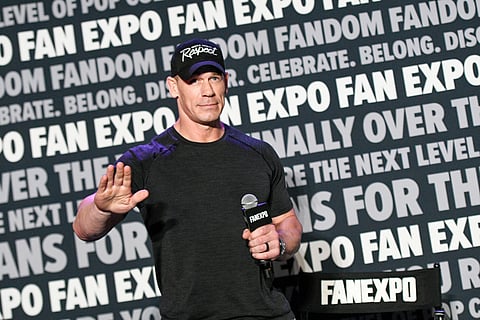
John Cena opens up on Joe Rogan's podcast | Image credits: Imago/ ZUMA Press Wire

When John Cena sat across from Joe Rogan on a recent episode of The Joe Rogan Experience, the conversation covered everything from wrestling icons to Hollywood. But the most revealing portion came when Cena opened up, unprompted, unguarded, about one of the most stressful, controversial moments of his career: the time a single teleprompter line, read at the tail end of a 10-hour press day, plunged him into an international controversy he never saw coming.
The setup sounded simple enough. Cena was doing global promotional shoots for a movie, one of those whirlwind press days where you record dozens of short messages for different regions, audiences, and platforms. Exhausted, running on fumes, he didn’t check a Mandarin teleprompter script that described Taiwan as a “country.”
In most contexts, nothing about that sentence would raise an eyebrow. But in the context of Chinese geopolitics, the phrasing is explosive.
“I didn’t check the reads,” Cena admitted to Rogan. “It was the end of a 10-hour day. I’d done a million of these things. I just read what was in front of me. It was a Ron Burgundy moment—go f**k yourself, San Diego.”
He laughed when he said it, but the laughter didn’t mask the seriousness of what came next.
Within hours of the clip going live, Chinese social media erupted. Studios panicked. The global PR machine spun into overdrive. And Cena, who had delivered the line with the full sincerity he applies to every language he speaks, found himself thrust into one of the thorniest diplomatic issues on the planet.
The part of the story that seemed to shake him the most was not the initial backlash - it was the backlash to his apology.
“To China, I had to apologize,” he said. “And in apologizing to China, I pissed off my home country.”
He described himself as a patriot. Someone who loves America deeply. But the moment he expressed regret in Mandarin, a new storm erupted in the U.S.
“No one was happy,” he said plainly. “Everybody was f***ed up.”
That sense of being squeezed between two emotional extremes—two national identities, two sets of expectations—was a shock even to someone accustomed to high-pressure environments.
“It was murky waters for me personally,” he said. “I was just trying to do something good. And then suddenly it felt like no matter what I did, it wasn’t enough for anyone.”
At one point, Cena says he even went to James Gunn on the set of Peacemaker and told him he understood if the controversy meant he had to be fired.
“I went directly to James Gunn and was like, "Hey man, if you have to fire me, I understand. It was that serious,” he said. “I genuinely didn’t know how bad it was going to get.”
What stood out most in the interview wasn’t the mistake—it was Cena’s insistence on taking responsibility for it.
Rogan, like many people, suggested the error must have been someone else’s: an intern, a PR assistant, a translator, someone far down the chain. Cena didn’t accept that.
“It was my fault,” he said, almost cutting Rogan off. “I appreciate the idea that someone else might have screwed up. But at the end of the day, I’m the one who read it. I’m the one whose face is on it. If I blame anyone else, I’ll never learn anything.”
Instead of building conspiracies around sabotage or incompetence, he rooted the event in humility. Exhaustion. Oversight. Human error.
The lesson, he said, was simple but profound: “Just because you know the language doesn’t mean you know the culture.”
Cena spoke genuinely about how much he had loved learning Mandarin. It wasn’t a marketing gimmick—it was a discipline, a craft, a respect for global audiences. He became especially skilled at reading pinyin, the phonetic Romanization that made memorizing tones easier. But the Taiwan line shifted his perspective entirely.
“I don’t have the cultural fluency,” he said. “I haven’t done enough research. I don’t know enough about the depth of what words mean in different parts of the world. So now, even though I can speak Mandarin, I won’t do it in a promotional setting. Not until I understand everything behind the words.”
He spoke with admiration about the countries he visits and the fans he addresses, but also with a clear sense of responsibility.
“I don’t want to say something that feels like a nice gesture to me but completely offends you,” he said. “That’s not good for anybody.”
Reaction vs. Reflection
Cena stars as the titular character in The Peacemaker | IMAGO / Independent Photo Agency Int.
Cena admits that the biggest mistake he made was not the line itself, but how fast he reacted once he realized people were angry.
“I should’ve taken a breath,” he said. “I should’ve waited, learned what was actually going on, figured out the best path forward. Instead I just said, ‘You want this fixed? Fine, I’ll fix it right now.’”
He shook his head at his own impulsiveness. “I didn’t fix the hole in the boat,” he said. “I sunk the Titanic.”
But again, he brought the lesson back to personal growth. “Don’t be reactive. Take a breath. That’s what I learned. And I learned it the hard way.”
Rogan, in his usual blunt manner, told Cena that he personally would have blamed anyone and everyone involved in writing or approving the line. Cena’s refusal to do so only reinforced the image of someone with a deeply ingrained sense of accountability.
“It speaks to your character,” Rogan told him.
But Cena didn't dwell on the praise. He shifted the focus back to what matters: learning, improving, and being humble enough to admit when something is beyond your depth.
By the end of the discussion, the controversy that once dominated headlines felt less like a political incident and more like a universal human lesson: in a world where one sentence can cross continents, the stakes of every word grow higher.
For Cena, the Taiwan episode wasn’t a scandal—it was a formative experience, one that forced him to rethink the intersection of language, culture, and responsibility.
He summarized it with a clarity that made the entire ordeal feel like a chapter in a much larger story: “It sucked. But it was a cool lesson. I learned something I needed to learn.”
**If you use quotes from the article, please credit the Youtube video and link to Sportshadow.com for the transcript**