
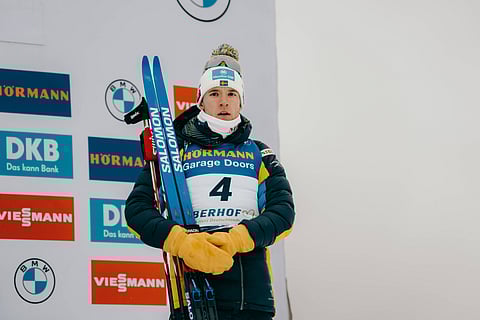
File photo of Sebastian Samuelsson | Credit: IMAGO / Gabor Baumgarten
Garage grind, countless calories and thousands of shots - inside biathlete Sebastian Samuelsson's preparations
Sebastian Samuelsson has lost count of the miles skied, shots fired and calories consumed during his Winter Games preparations but the Swedish biathlete knows his gruelling training regimen will pay off when the going gets tough in the Italian Alps.
Samuelsson, who won a relay gold at the 2018 Pyeongchang Games and a silver in the pursuit, told Reuters that the key to his success is consistency in training.
"It's far from every day that I wake up in the morning and think that it's going to be great fun to train, when there's bad weather, you're tired or you're worn out," the 28-year-old said.
"But I think my biggest strength is that I train anyway - and when I train, I make sure to do the workout as well as possible. That, I think, is my biggest strength."
The biathlon competitions get underway at the Anterselva Biathlon Arena on February 8, and Milano Cortina will be Samuelsson's third Winter Games after he finished out of the medals in Beijing four years ago.
It has been a long journey.
"We started training on May 1 last year. We did some training at home in Sweden first, and then we went to a training camp together with the Swedish Olympic Committee in Crete," Samuelsson said.
"We were there for a week, and then we just continued throughout the year.
"A lot of people seem to think that we train a lot during the winter and so on, but it is between May and November that most of the training takes place."
Samuelsson said he was unsure how much ground he had covered in training for the Games.
"I don't really know how many miles I've skied altogether but we've probably trained about 100 hours a month and then during a training week in the winter we train 10 to 15 hours a week, or around half of what we do through the summer," he added.
On top of that, Samuelsson does two or three strength training sessions a week and spends lots of time on the range, where he estimates he shoots around 20,000 .22-calibre bullets over the course of a year.
The Swede shot to fame at the 2018 Olympics by snatching a surprise silver in the men’s 12.5km pursuit behind French biathlon legend Martin Fourcade.
And he went one better a few days later, winning a sensational gold medal with his Swedish teammates in the men’s relay.
That success has enabled him to build a gym in the garage of his house, just outside the Swedish town of Ostersund.
“I have a big treadmill there that I can ski on. If I hadn’t been a biathlete and was a cross-country skier instead, I could just train there all the time, but the shooting means I have to go out to practice,” he said.
"During the recent Christmas period it was very good, because it was very cold outside, and I could get a good workout inside the house.”
All of this exercise requires fuel and Samuelsson puts away a huge amount of calories when he has to.
"I don't usually count the calories every day ... but the toughest training days, I consume somewhere around 6,000 calories," he said. "That's about three times what a normal man would eat."
(Reporting by Philip O'Connor; Editing by Peter Rutherford)
