
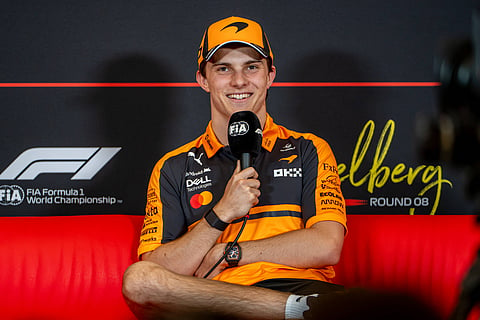
Oscar Piastri attends the press conference | Credit: IMAGO/Beautiful Sports
McLaren need 'new bits' to catch F1 leaders Mercedes, says Oscar Piastri

Formula One champions McLaren will test an experimental rear wing in Austrian Grand Prix practice but are not yet ready to race with it, Australian driver Oscar Piastri said on Thursday.
McLaren finished one-two at the Red Bull Ring last year on their way to winning both titles but are currently third in the standings, a whopping 121 points behind leaders Mercedes after seven rounds.
"It's to test out," Piastri told reporters at the Red Bull Ring when asked about the new development.
"Obviously we’ve seen some of the creative solutions and they don’t come without their challenges, clearly. So yeah, it won’t be raced, but useful to try it out."
Piastri has had an up-and-down season, with the Australian failing to start the first two races in Australia and China but then finishing second in Japan and third in Miami.
Teammate Lando Norris, reigning champion and last year's winner in Spielberg, was second in Miami and third in Barcelona this month.
"We have a bit of a deficit everywhere. We don’t really have any clear strengths where we’re really strong, but we’re not terribly bad anywhere either," said Piastri.
"To catch Mercedes, and we’ll see whether Ferrari maintain their form as well, we need to put some new bits on the car, we need to make it faster, and we need to do it quicker than everyone else.
"Things are quite different to last year in a number of different ways but it’s up to me to be able to adapt to that. I think in certain situations I have adapted very quickly. In others, I haven’t adapted as quickly as I need to. So, still plenty of learning."
Piastri said Mercedes, with Kimi Antonelli 41 points clear of Ferrari's Lewis Hamilton in the championship, remained the benchmark but the situation could change quickly even if the odds were currently stacked against McLaren.
"I think maybe we can get close again but we’re kind of relying at the moment on the others getting it a bit wrong or having things go our way rather than being the ones on the front foot and able to set the pace," he said.
"We’re very conscious that we need to improve things and for things to change for us but I don’t think we should count ourselves out."
(Reporting by Alan Baldwin in London; editing by Clare Fallon)